TIPS & INTERESTING ARTICLES FOR FIELDWORK IN SPAIN

Here, you will find information on qualitative research and a variety of suggestions to bear in mind when planning to carry out fieldwork in Spain. Most of the tips and articles are coined by us but we are very much in favour of making reference to other author's links whenever we consider they may be useful to market research practitioners.


jueves, 19 de abril de 2012

How Simultaneous Interpreting Can Best Communicate Meaning And Nuance In Foreign-Language Focus Groups

Research practitioners know the impact that interpreting can have on work.  Poor interpretations can give clients the wrong impression as to what they are hearing and its significance. More importantly, if the QRC is not acting as the moderator nor speaks the group’s language, he or she can also be misled by inaccurate interpreting, which can skew the QRC’s final report. Thus, it is worthwhile to explore the nature of focus group interpreting and examine the benefits derived from using professional moderator-interpreter dyads to avoid the pitfalls of standard translation services. This article was selected by the American Market Association for its Resource Library.

If viewing your foreign focus groups is important to you or your clients, you may have wondered: How can we deliver the messages across the one way mirror in the way they emerge from the focus groups?

This is where simultaneous interpreting (also called simultaneous translating) comes in. As research practitioners, we know the impact that interpreting can have on our work. Poor interpretations can give clients (who are watching the groups) the wrong impression as to what they are hearing and its significance. More importantly, if the QRC is not acting as the moderator nor speaks the group’s language (which is common when American QRCs must carry out focus groups outside the U.S.), he or she can also be misled by inaccurate interpreting, which can skew the QRC’s final report. Thus, it is worthwhile to explore the nature of focus group interpreting and examine the benefits derived from using professional moderator-interpreter dyads to avoid the pitfalls of standard translation services.
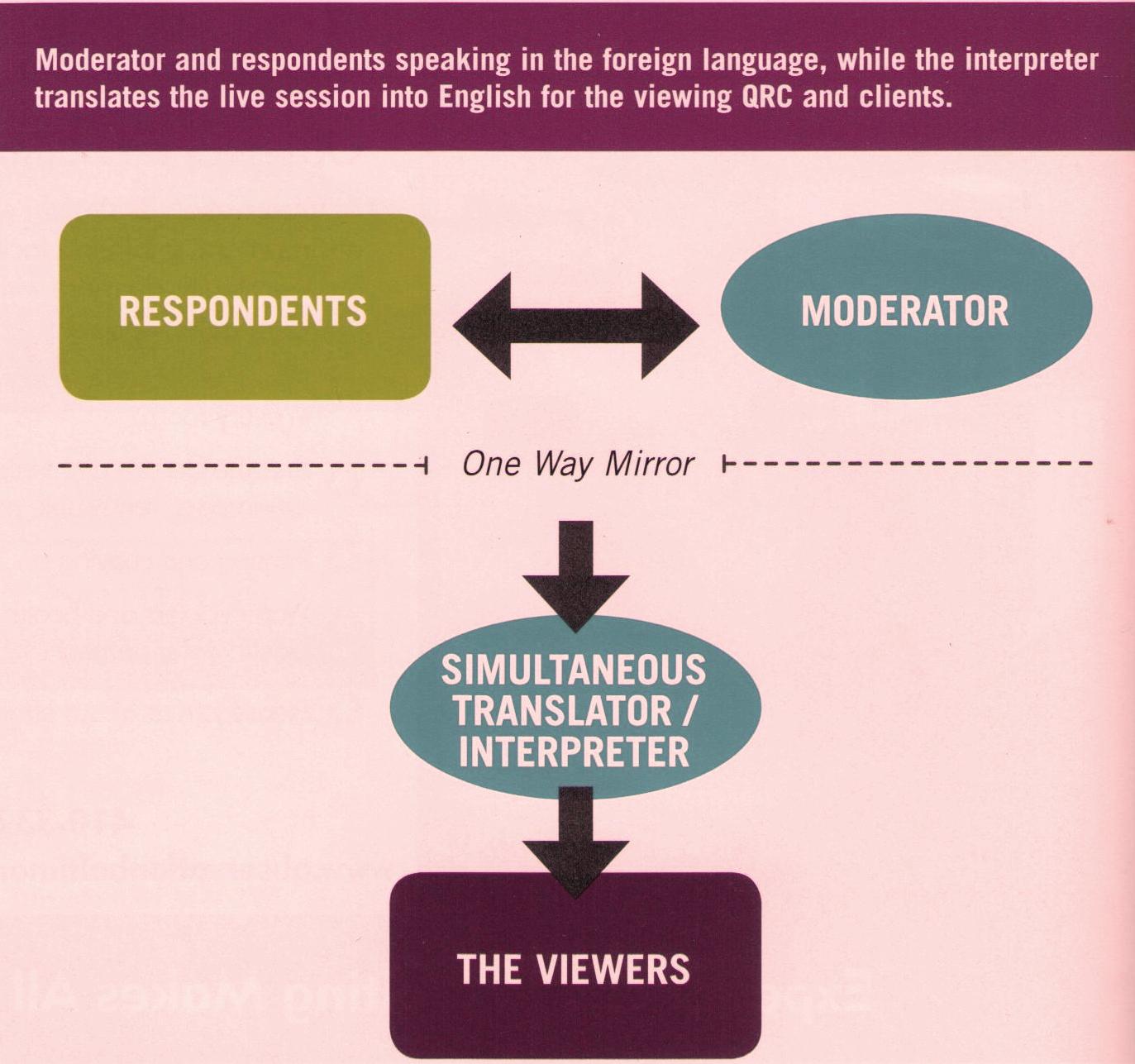
Interpreting and translating can be used interchangeably. In this article, I often refer to interpreters, rather than translators, to highlight the added complexity that comes when attempting to communicate not just the words a respondent says but the fullness of meaning that can be lost on those who do not speak the language and understand the cultural references.


Before exploring how to improve the interpreting itself, we must first be aware that the message received is directly influenced both by the interpreter and by how the focus group viewers process what they see and hear. In reality, simultaneous interpreting is a complex process that occurs in the interpreters’ minds and is thus limited to their own comprehension of the group discussion and its subject matter.

We should also acknowledge that cultural barriers and the pace of simultaneous interpreting may sometimes confuse foreign viewers. The seconds in between one statement and its translation can present an obstacle to getting the message through to the back room.

Likewise, it may lead to the misinterpretation of body language or cause a viewer to lose track of which speaker the interpreter is referring to.


In fact, we cannot control the way speech is processed by the relevant parties, but we can minimize misunderstandings by helping ensure that the message is conveyed correctly. This highlights the importance of transmitting the message in its entirety, with its cultural load, feeling and intention.


In a successful simultaneous translation, the interpreter’s speech flows naturally at the pace set by the group discussion. It appears to be the result of a rare ability based primarily on intuition, instead of what it really is: the culmination of a long process in which instinct, skills and preparation converge.


Indeed, we can minimize the problems that hinder the flow of communication towards the viewing room when we acknowledge that simultaneous interpreting for focus groups is quite different from any other form of translation. To prepare for a successful interpretation experience, consider the following.

Simultaneous interpreting for focus groups requires additional preparation.

Conference and focus group interpreting demand adequate preparation. Simultaneous translators/interpreters need to study the background material and ascertain whether or not their subject knowledge is sufficient or should be brushed up in time for the event.

Preparation for a focus group, however, requires additional efforts, as the interpreter needs to thoroughly study the discussion guide (aside from other materials) so as to understand its rationale from a marketing perspective. The interpreter needs to be ready to convey the information that is of interest to the client, even if the moderator jumps from one subject to another, following the flow of ideas. Clearly, this can only be possible through conscientious preparation and two-way communication between the moderator and the project leader.

The briefing should include the interpreter.

Successful interpreting at a conference or during a focus group session must take the viewing client — and the QRC, if he or she is in the back room, rather than moderating the group — into account. Even if interpreters are properly prepared for the event, they will require briefing on the day it occurs.


During the briefing, the project leader and the moderator update the simultaneous interpreter on the latest considerations (special requirements, timetables, etc.) and offer suggestions to help the interpreter finetune the translation to the audience’s level of expertise. A focus group briefing runs much longer than a briefing for a conference, since it focuses on study objectives and identifies different considerations for each section of the questionnaire.

This is the time for interpreters to raise questions and clear up any doubts.Only in this way will the interpreter be able to capture the participants’ relevant reactions.


The interpreter’s role

When working at a conference, simultaneous interpreters aim to deliver a coherent, clean and accurate speech. For market research purposes, the emphasis falls on the ability to convey a message that is richer than the words themselves.

In this respect, simultaneous interpreting for a focus group may be much more challenging, as the interpreter must communicate not only the verbal content, but also the respondents’ impressions, their doubts and feelings, their body language and their reactions to the ideas discussed.

Thus, the interpreter conveys the multiple signals that comprise the message: the context, the line of the argument and the degree to which respondents react to a given situation. This kind of performance facilitates comprehension in the back room, allowing viewers to focus on those points that are valuable for the project. That said, however, the role of the interpreter is limited to translating what the participants say, and it is not, in any way, related to explaining or analyzing the meaning, the implications or the impact of what participants say, which is the QRC’s role.


Interpreting for focus groups

Following up and communicating a piece of conversation in a way that is meaningful for the research requires a set of skills and organizational capacity that do not compare with conference interpreters’ usual assignments, in which a single line of speech is followed. Experienced simultaneous interpreters for focus groups are used to interpreting while discussions take place amongst participants, who under normal circumstances speak simultaneously, overlap and interrupt each others’ lines of argument.

This turns interpretation into a fine art in which the simultaneous interpreter has to perfectly understand the connotative message delivered by the source speaker(s), then reconstitute it and adapt it to the audience, in its own language and in “real time,” while considering the marketing objectives.


Changing needs, changing instructions

Generally speaking, conference interpreters receive a set of instructions that remain unchanged during the assignment. Conversely, the nature of the instructions addressed to market research interpreters is dynamic and characterized by change and development; in fact, the instructions evolve with the flow of the focus group dialogue.

Furthermore, while conference interpreters normally work in an enclosure and have minimal or no interaction during their shifts, market-research simultaneous interpreters must be open to receiving input from the client or the moderator at any time. In reality, they have to be in sync with both in order to do their job properly.

Having examined the distinctive features of interpreting focus groups, and prior to assessing the improvements brought by using moderator-interpreter dyads, we should look into whether or not it is appropriate to assign all our market-research projects to the same interpreter.


Context Matters. Interpreters with Industry Experience Help.

A couple of months ago, I moderated focus groups with motorcyclists and professional racers. One of my objectives was to trigger a discussion about their motorcycles’ performance, and we expected that participants would engage passionately on the subject of mechanics. As we did not want to miss that information, the approach to the project called for a simultaneous translator who understood the mechanical jargon within the context of the racing world. I gave a clear briefing to the facility, and it hired an interpreter who did a wonderful job.

We can assume that a simultaneous translator who does a good job in one particular field may not be the best alternative to cover another. Previous experience interpreting focus groups and a degree of specialization on the subject matter to be researched are prerequisites to qualify for assignments. Not any professional interpreter will suffice.


The Moderator-Interpreter Dyad Improves the Outcome of Interpreters.

Over the years, I have become increasingly aware of the risk involved in not considering the benefits derived from mutual understanding between the moderator and the interpreter; the importance of their working synergy and alignment behind a goal is obvious when the focus groups begin.

In my view, improving the outcome of simultaneous interpreting requires a comprehensive approach, such as that provided by professional moderator-interpreter dyads. To achieve project success, it is vital that the moderator and the interpreter are acquainted with each other’s needs. Only in this manner would the interpreter be able to capture the participants’ relevant reactions. When the interpreter is familiar with the objectives of each section of the questionnaire and understands the purpose of the qualitative exercises, it is more likely that the recipients will receive meaningful information.

In fact, pairing moderators and interpreters produces an overall better result than if each professional were working toward the same goal individually. When the two prepare the session together, share their knowledge and doubts, work as a team to sharpen their abilities, and are ready to support each other if the opportunity arises, we can expect better results. For instance, the moderator can ask participants to speak louder or more slowly or to speak in turns, showing concern for the interpreter’s task. As for the interpreter, in the midst of the discussion, when everybody overlaps each other, he or she can focus on the lines of speech that are, according to the brief, more relevant to the research objectives.

Therefore, the key advantage of hiring a moderator-interpreter dyad is that two members pair up to reach a common goal: fulfilling the QRC’s designated need. Assuming that both are experienced professionals instinctively alert to their individual roles, their ability to be attuned to each other during the group discussion will result in the richly detailed and organized representation of the focus group experience that we, as practitioners, require.

Of course, moderator-interpreter dyads are not readily available everywhere, but this should not prevent practitioners from using their valuable contribution to their work at every opportunity. Essentially, these dyads are a synergistic response to the real issues posed by interpreting in the context of group discussions.

By Aníbal Marrón (1)

(1)Aníbal Marrón is Managing Director of MG Business Research Solutions and Partner at A Window. He is a consultant specialised in positioning and help organizations by suggesting actionable solutions to market situations.

miércoles, 28 de marzo de 2012

Sustainability of the Spanish Public Healthcare System

At present, Spain is undergoing rapid changes to streamline its economy and reduce its deficit. The effects of these changes affect not only the man in the street but also the pharmaceutical industry. This article describes some of the changes that are likely to happen and comments on the potential implications that they may have on patients.

The economic crisis in which Spain finds itself has made apparent the need to reorganize the public health expense.  In fact, right now the national government has placed high on the agenda the importance of developing strategies to minimize costs and maximize the efficiency of the resources of the system. Along these lines, some regional governments have already made cuts to achieve a reduction of the budget deficit in the health area and have even considered the introduction of co-payment.

Some of the measures taken are aimed at the restructuring and reduction of the expense in drugs. This expense in itself reaches close to 25% of the total healthcare expense, which for Spain represents approximately € 3,750 million yearly. This comes as no surprise if one takes into account that the pharmaceutical expense in Spain is one of the highest in the world (1) and much above the average expense of the countries that make up the Organization of Economic Cooperation and Development (OECD).

Some Measures That Aim At Cutting the Expense in Drugs
In keeping with this goal, the Royal Decree 9/2011 has introduced a modification to the law of reference prices. It implies that when a drug loses its patent (>10 years), whenever there is a generic or biosimilar drug the public health system will finance only those drugs which have the “lower price”. Besides, products that have lost their patents will have to lower their prices a 15% in a mandatory way (2) even if there is no presence of generics or biosimilars in the market. 

While these measures tend to exclude from the reimbursement system all those drugs that do not adjust to a given price, there are also actions intended to encourage a more rational use of the drugs -such as the implementation of single doses- and efforts to obtain better conditions in the negotiations with the pharmaceutical industry.

In connection with the latter, the central government put forward the following:
a) A yearly review of the prices of the reimbursed drugs. This would open a window for renegotiating the prices downwards or leaving some drugs out of reimbursement depending on their use and turnover.
b) The instrumentation of a national purchasing centre to negotiate better prices with the pharmaceutical industry for certain kinds of drugs (3).

Other proposals for the sustainability of the system and/or the reduction of the expense have come in some regions from the Entrepreneurial Federation of Spanish Pharmacists (FEFE). One of these consists in excluding from public reimbursement the drugs aimed at minor pathologies which cost under € 2 –the exclusion would not be applicable to chronic or poly-medicated patients. If this proposal were implemented, the patient would take a bigger role in the choice of some drugs.

It is clear that if these changes take place and the trends settled, they will lay the foundation for new game rules, giving a greater role to other actors and modifying power relations.

For the health system, getting out of the crisis will require making difficult decisions and will entail new challenges and opportunities for the pharmaceutical industry. Another reality is taking shape, which will have to be explored. It will impact upon the standards of service that the patients get, the drugs prescribed, the balance between the parties and the way all of it is perceived by the citizens.

By Gimena Rodriguez, Field Director with A Window.

(1) http:/www.elmundo.es/elecciones-generales/2011/propuestas/propuesta78.html
(2)BOE State Official Bulletin Nº314. Friday 30th, December 2011-Sec 1 Page 145936
(3)The products which might come into the purchasing central would be: vaccines incorporated in the common vaccine timetable of the national health system, the seasonal flu vaccines of the winter 2012-2013; the antibiotics of most common use, such as amoxicilin, amoxi-clavulanic acid, cefazolin, gentamicin, and others: the antiviral drugs (zidovudine, aciclovir). Erythropoietins, and the growth hormone, the antineoplasics with generic or copy, such as Paclitaxel, Oxaliplatin and others and the serums and other health products such as alcohol, gauzes, poultices, or urine absorbents.  

AN INTERNATIONAL MARKETING RESEARCH CHECKLIST (*)

Checklists help with major undertakings such as moving across county or preparing for a long vacation. A checklist could be equally helpful for a global marketing research project. This article provides a checklist for such an endeavor.

Have you ever moved across the country with a professional moving company, or taken a long vacation and consulted with AAA or a travel agent? Often, these organizations will give you a checklist to insure success in such a major undertaking.

Well, guess what? A global marketing research project is also a major undertaking! So why hasn’t someone put together a checklist to help marketing researchers and other professionals navigate the rough seas that can threaten the validity and actionability of these projects?

Below please find your checklist, which can be copied for your convenient use and that of your colleagues.

I have written this list from the point-of-view of a researcher who may plan either to use a coordinating marketing research firm or to directly field a study in international markets. In either case, the issues and concerns in the checklist are the same.

General
  • Does the local in-market research firm being used to field your study have 10 or more years of experience in fielding research in each country they are responsible for (or, at least six years in markets that weren’t open until ’90—’91, such as Eastern Europe), so that a strong understanding of local cultural variables and appropriate study design is available?
  • Has the questionnaire/discussion guide been translated to the local language by personnel who currently speak the local language day-to-day, and who are therefore up-to-date on current meanings, usages and slang, etc.?
  • Has the local language questionnaire/discussion guide version been back-translated to English, again by personnel who are current speakers of the local language and English?
  • Is your study benefiting from consulting help from your local in-market research firms at the stages of determining local study methodology, questionnaire/discussion guide design, and again during analysis of results?
  • Is your study being fielded by local companies that have the correct level of expertise for the study at hand and who have sufficient experience and caring to brief and monitor fieldwork, and to validate the results of the interviewing?
  • Have you arranged for translation of briefing materials, respondent stimuli (including any videotapes), etc., into the appropriate local languages? In addition, have you ascertained the appropriate format for any videotaped stimuli (i.e., PAL, NTSC, etc.)?
  • If there are study requirements that include the need for certain water temperatures or for amounts of different items such as in a recipe, are these requirements expressed in understandable terms for all countries included in the study (i.e., Fahrenheit versus Celsius, metric versus English measurements, etc.)?
  • If a certain study has requirements for electrical equipment, such as a particular computer or an appliance that must be demonstrated, have you determined that appropriate electrical adapters are available so that the equipment can be used in each country?
  • Have you checked for recent major weather or other events, such as the large forest fires in Mexico and Indonesia which caused smoke to travel over vast areas of surrounding countries? These events could have a major impact on planned research, especially research that depends on sensory perceptions of taste and smell.
  • Have you checked for possible political issues with respect to conducting research in each country? As an example, Indonesia places a moratorium on conducting polling or marketing research three months prior to a national election. Such local regulations may affect your ability to deliver research results on time.
  • Have you allowed for possible lengthy delays in customs for certain types of product in certain countries? Again, this can cause major problems in conducting work on time.
Quantitative
  • Have you dealt with the actual fielding of the study within each country in terms of the cities that are selected, and assured that each cell of the study is receiving the identical geographic spread within each country (across cities, etc.)?
  • If you are conducting a multi-country study, are editing, coding, data entry, and data tabulation functions centralized with consistent decision-making and oversight?
  • If you are conducting a multi-country study, have you designed the questionnaire so that different brand lists can be fielded in each country, and so that identical brands can be easily identified and tabulated across all countries where they are found?
  • If you plan to view the results of your multi-country study in total, have you assessed the need for the cross-calibration of any scalar data, so that results are able to be combined and analyzed across cultures?
  • Have you considered the need to create more than one questionnaire per country, depending on the number of regional dialects or even indigenous languages that may exist?
  • Do not automatically assume that a CATI telephone study as it is fielded in the U.S. is also the appropriate method for international markets. You very likely will need to go to door-to-door interviewing or some other type of face-to-face approach, such as hall interviewing with street intercepts. Here is where local consulting advice is critical in getting the job done right.
Qualitative
  • Have you secured moderators in each country that have the appropriate language and cultural fit to relate well to respondents and elicit their feedback?
  • If personnel are attending who do not speak the local language, have you arranged for simultaneous translation? Have you also arranged for audiotaping of the simultaneous translation, along with videotaping of the interviewing?
  • Although you may be used to using one moderator across all cities in the U.S., have you checked for the need to use different moderators within the same country in international markets, due to different cultural situations and languages/regional dialects?
  • If you or your colleagues do not attend qualitative work internationally, have you arranged for transcripts of the interviewing to be created and translated to English? And, have you arranged for these English transcripts to be sent to you electronically?
  • Have you arranged for briefing of all moderators, either in-person or via long-distance conference call, depending on whether you are traveling to the interviewing sites?
  • Have you determined if a viewing room with a one-way mirror is available, or whether a video set-up is available for observing the interviewing?

It is important to review all of these issues when coordinating international/global marketing research studies. Others may arise that have not been included here. If so, I would be very happy to hear about them. Meanwhile, enjoy the opportunities global/international work can provide - and may you do so as successfully as possible.

By Kent Hamilton
Vice president/Director of international services at A&G Research, Inc., New York.
(*) This article was originally published in November 1998 by Quirk’s Marketing Research Review. (Article ID:19981109)

viernes, 4 de noviembre de 2011

QRCA 2011. The day after

Congratulations to QRCA for the 2011 Annual conference!

This year the QRCA conference was in Las Vegas, Nevada.  Not surprisingly, one of our partners was very much into going to learn, connect and have fun.  As soon as he came back, we wanted to know his impressions.  What follows is what we have got from him after nine hours of jetlag:

How about the conference?
The conference program, the luxury Venetian Palazzo Hotel and Las Vegas, everything was just perfect.  As for the conference, I would say that it was a complete success. 

What did you find more remarkable?
Fist of all, I would like to thank the organizers for the great job they have done and also to the conference committee that selected the presentations because there were interesting topics to choose from at any time. 

Ok, I guess that most of the presentations have had a fairly good level…,
Yes, but the conference was not all about presentations.  There were master classes, round tables, SIG meetings and many opportunities to contact with fellow professionals consultants. 

Has there been any particular session that had a bigger impact upon you?
I don’t want to be unfair to others presenters because I haven’t been to all the sessions.  By choosing one workshop I was missing another.  Do you see what I mean? However, what impressed me most was the way in which Pat Sabena, Judy Langer and J.R. Harris explored the subject “Triggers that lead to changes in lifestyle”; they all worked on the same briefing but the master class showed their different ways to approach the issue and elicit the information while moderating.  This is the kind of thing that makes this conference unique.  Leading consultants are not afraid to share their knowledge.  Other than that, I have also enjoyed very much the session “Interpreting Ethnography for Actionable Insights”, presented by Bill Abrams and John Holcombe.

So, what would you say that is your overall impression?
I am very happy to have been present in Las Vegas.  There are many important conferences around the world but QRCA is definitely one of my favourites. 

Thanks a lot; you can have some sleep now.


viernes, 8 de julio de 2011

Improving Feedback By Using Moderator-Interpreter Dyads

Enhance the output of your simultaneous interpreting by hiring a moderator-interpreter dyad

Improving the outcome of simultaneous interpreting requires a comprehensive approach. Arguably, moderator-interpreter dyads are the synergistic alternative that focuses on the needs of practitioners to address the drawbacks of standard interpreting.

To achieve success in interpreting, it is essential that the moderator and the interpreter are acquainted with each other’s needs. Only in this manner would the interpreter be able to capture the participants’ pertinent reactions. When the interpreter is familiar with the objectives of each section of the questionnaire and understands the purpose of the qualitative exercises, it is more likely that the recipients will receive relevant information.

Moderator-interpreter dyads are one of the best ways to avoid the drawbacks of standard interpreting in focus groups. Unlike the outcome delivered by interpreters without actual understanding of the marketing project, the pairing of moderators and interpreters promotes the overall comprehension of the study so they are both working towards a common goal, which in turn encourages the ability to convey not only words but connotative information that is vital to the projects.

Dyads offer a pro-active approach whereby all the parties that have an effect upon the interpretation process work together to acknowledge: a) the market research aims for the project, b) the techniques that the moderator will apply during the focus group and c) the type of audience that will receive the information. Only when the interpreters take these aspects into consideration do they learn to differentiate the information that is significant and gain competence to intensify the flow of meaningful messages towards the viewing room.

More precisely, moderator-interpreter dyads improve the outcome of interpreting as follows:
  • Facilitating collaboration between moderator and interpreter with a view to delivering accurate messages instead of simply words
  • Ensuring the interpreters’ understanding of the marketing objectives and the adequate preparation of the qualitative exercises.
  • Reducing the impact of cultural barriers by facilitating the communication of the whole message, which includes feelings, intentions and cultural load
  • Promoting the transmission of relevant messages.
  • Allowing interpreters and moderators to tap into their common experience to approach the singularities of each project and cope with new situations.
  • Helping practitioners to analyse the information.
Thus, dyads are a synergistic solution that allows practitioners to fully grasp conversations. They provide the comprehensive kind of interpreting that is required by international clients and practitioners alike.

By Marina Gonzalez, bilingual qualitative researcher and moderator. Partner at A Window.

Choosing Interpreters

Intangible benefits of hiring translation services from a viewing facility
The moment of the truth when choosing interpreting services comes before you decide what company to work with. It is the moment when you evaluate the differences between the available services. This article comments on the advantages of hiring translation services through A Window

Sometimes the decision to pick the right interpreter may appear to be quite easy. You may have one interpreter you have already worked with or a freelancer who has been highly recommended to you. Also, you may be thinking of hiring one interpreter from a local language services agency or you may rely on the local facility that is setting up the project. You may think that it is all the same, but it is not. Let us briefly explore these options.

Freelancers
Perhaps the most disturbing consideration when hiring a freelancer is that we know little about what his/her speciality really is. At this stage, previous jobs will only be worthy of consideration if the subject matter of the project is similar. This is irrespective of him/her being recommended or known to you. It may be a mistake to assume that an interpreter will perform equally well in any field.

Language service agencies
They will surely have several interpreters available and can be very handy if a particular specialization is a requisite or the agency has already translated the materials for the project. Specifically, this may work quite well for face to face interviews. However, working at a market research facility is quite different from working at a conference. By way of example, we often find that some interpreters feel uncomfortable having to translate focus groups or having to interact with executives or clients behind the one way mirror, since they are not used to doing so. Thus, a background in market research assignments is arguably a non-negotiable requirement.

Viewing facilities
The services provided by viewing facilities vary greatly according to the country, the city and their client base. In Spain, they range from those that serve as a link between you and the interpreter but relinquish any responsibility for the outcome of the service to those that offer interpreting as a regular service and have available specialised teams comprising moderators and interpreters.

Any of the above may provide good services but there is a feeling amongst many practitioners that interpreting gets a plus when it is the outcome of an interpreter-moderator dyad. Our recommendation is that practitioners should carefully examine the benefits to be gained with each service available, analyse the impact that interpreting has upon their work and then judge by themselves what supplier is in a better position to give a plus when fielding focus groups, for instance.

Nevertheless, there is added value in commissioning translation services through a viewing facility. It may be self evident for some practitioners but it is worth outlining briefly. In fact, by hiring interpreting services from A Window, practitioners tap into our know how and obtain intangible benefits such as:

  • Project coordination. It is advisable to have a local project leader accountable for every part of the project; namely, special requirements, viewing facility, translation, interpretation, recruitment, moderation, timetables, etc. It also guarantees first-hand information and active involvement throughout the project.
  • Consistent results across all fields of research. Whatever the service requested, we look for the most adequate interpreter/translator for your assignment; thus, professional translation and interpretation is guaranteed. We know that each project has unique requirements. Therefore, we carefully pick interpreters and translators according to their individual profiles. To promote maximum efficiency, we have developed a translator pool from which we can draw personnel for your marketing assignments. Furthermore,if the right one is unavailable, our language agency partners, which are ISO 9001:2000 and UNE EN 15038:2006 certified, will provide us with fully qualified professionals.
  • Reliability. Confirming proper market research experience and specialization ensures that interpreters will work comfortably with the requirements of focus groups or face to face interviews.
  • Objective advice. Our recommendations may lead to savings and better performance. For instance, live interpreting may be exhausting for a given assignment but we are ready to advise you whether your project requires one or more interpreters.
  • Specialization. Benefit from the accumulated experience of interpreters, translators and dyads. Moderators, interpreters and translators gain confidence with every project and feel better equipped to tackle a wider range of situations. In particular, dyads need time and planning before being fully fledged. To nurture their development, we facilitate their working meetings and assist them in many different ways. Thus, the knowledge acquired in each project may be applied to the next.
  • Availability of moderator-interpreter dyads. At present, we have several working dyads readily available. The availability of this service is the conclusion of a long process of selection, development and specialization. Pairing up individuals adequately not only requires being acquainted with moderators and interpreters but also knowing their background and their skills. We only pair up bilingual English-Spanish individuals who have proven to work well together. Some of the characteristics we usually look for are: good interpreting skills, subject specialisation, openness, previous positive experiences and general awareness of market research.
From day one, A Window has developed bespoke written and simultaneous translation services based on the belief that market research is in itself a specialization that cannot be underestimated under any circumstances. Furthermore, the fact that we have fostered the development of moderator-interpreter dyads for over two years shows the way we understand the market research business.

Hiring moderator-interpreter dyads through A Window is as easy as making a phone call and it gives a plus to the interpreting of marketing research assignments such as focus groups. Do not hesitate to benefit from this far-reaching approach!

lunes, 11 de abril de 2011

Qualitatively Speaking:

A little homework can work wonders(1)

Respondent homework assignments, such as collage-building, audio recording of spontaneous impressions or "thought log" diaries, can improve respondent bonding and increase productivity.

Depending on the goals of a specific qualitative research assignment, it can be highly productive for respondents to arrive at focus groups thoroughly primed and well-immersed in a particular category. In order to accomplish this, a skilled moderator calls upon various tools and techniques in the form of respondent homework assignments. These might include activities such as collage-building, “thought log” diaries, audio recording of spontaneous impressions, cognitive sequencing and in-situ product photographs, to name a scant few. A broad array of tools and techniques can be used in tandem or individually, depending on appropriateness and project objectives. While there is obviously no one-size-fits-all application of these techniques, it is generally felt by this moderator that some form of respondent preparedness can enhance many qualitative investigations by heightening the depth and breadth of insight and learning.

The premise here is that when respondents are thoroughly “into” a particular subject matter, on a premeditated level, they are more psychologically and verbally equipped to contribute, in a meaningful way, to the specific research goals at hand. This preparedness, in turn, combats what we as qualitative researchers and clients have all, at one time or another, disappointingly experienced: the cocked heads and quizzical, empty stares of respondents reacting to questions that, from their perspective, come far out of left field, jarringly out of context with their everyday living experiences and thought processes. This is sometimes what happens when clients and researchers are too close to their products, when objectivity and an unbiased perspective are lacking. Why we do research, after all, is to gain deep insight into how consumers conceptualize and think about a particular category, how they filter choices and actually use a given product, brand or service. This is great, but let’s give our respondents some useful tools to help them dig beneath the surface to produce information that is truly revelatory and useful to brand and marketing groups.

Take for example the goal of getting to the core of brand image/essence in repositioning and branding work. Asking respondents to create separate collages epitomizing a competitive set of brand values, for instance, can really help unearth image distinctions and nuance - and reveal thoughts, feelings and associations which may otherwise be extremely difficult for respondents to articulate. There are other reasons for using this type of tool: Groups are simply livelier and more productive from the get-go. Following brief introductions at the beginning of the actual focus groups, discussion kicks off energetically with respondents telling the “story” of their collages (or other homework assignments), interpreting with ease what the visual images mean to them.

In designing effective qualitative study methodologies, researchers and clients should, therefore, carefully consider whether or not respondent preparedness will benefit study output. Homework assignments may well yield a number of advantages relative to strengthening group dynamics and, therefore, the quality of the learning that ensues:

• Respondents immediately interact and bond with one another, resulting in less lost time due to respondent warm-up. When respondents arrive at focus groups with some form of homework assignment in hand, I have observed that they are far more likely to get acquainted with one another in the waiting area, which in turn reduces the amount of time required for group room warm-up. To set this interplay in motion, I typically drift into the respondent waiting area and announce that everybody in our group has, for example, kept a diary chronicling how kitchen remodelling decisions have been made - how design ideas were filtered, if and how husbands contributed to the overall process, the role of professional design consultants, what the biggest headaches were, etc. Given the animated discussion that usually follows, respondents then enter the group room with a sense of camaraderie and shared experience, which makes much of the standard introductory sequence superfluous.

• Groups are more productive from the get-go. Given the above scenario and enhanced levels of familiarity and ease, respondents are ready to jump right into conversation. Because they have already essentially bypassed stiff, ritualistic introductory formalities (e.g., name, work, household composition, etc.), respondents are primed and ready to contribute to the heart of the research endeavour with deeper and more revelatory insights. This is not to assume, however, that every research topic lends itself to this approach. While waiting-room conversation about interior design decisions can, for example, be encouraged with highly involving, positive results, issues of a highly sensitive and/or personal nature - subjects involving potentially embarrassing topics such as incontinence, female pattern baldness, impotence - obviously do not lend themselves to this type of uninitiated, open waiting-room discussion. In these instances, homework assignments such as diaries, sentence completion exercises, adjective check lists and storytelling may be better used as private instruments shared only with the moderator.

• Descriptions/portrayals of brand persona are animated and involving - and respondents are more able to verbalize emotional and multi-sensory responses that are otherwise difficult to articulate. Homework assignments involving all types of collage-building, cartoon drawing, fictionalized balloon dialoguing, and personifications are particularly useful to help respondents differentiate within categories that may be functionally commoditized. Take for example cooking oil, specifically corn oil. Without homework assignments and the application of projective techniques, home-makers in groups were unable to delineate, to any significant degree, between oil brands. When asked to develop collages at home that epitomized the respective brands, however, rich descriptions revealed brand-differentiating imagery which was firmly rooted in regional cooking traditions and the trans-generational influences of one’s mother, even grandmother.

• The subtleties of situational context and spontaneous thought can be captured as they occur, rather than through the potentially distorting filter of recall. We all know what it’s like to try to reach back into the deep recesses of our minds and recreate a specific situation or set of circumstances - perhaps a range of conflicting emotions we felt at particular point in time, what factors influenced a specific buying decision, how a fragrance or aroma affected our mood, what distractions may have pulled us away from initial impulses, how the advice of a good friend or coercive salesperson may have eroded our buying convictions, etc. The point here is that, with the passage of time, our memory of occurrences gets clouded, and it is virtually impossible to reconstruct in focus group rooms many spontaneous thought processes. Recording this information through various homework assignments can, however, document this invaluable information.

• The resulting expression of nuance can be useful for ad agencies and creative development. Client teams are able to quickly distil what brand essence and usage scenarios are all about.

Worth the effort
While it may cost researchers more time in terms of upfront planning and preparation, the application of homework assignments can often be worth the extra effort. An experienced moderator can determine whether or not this approach will benefit a given study and set of research objectives.
By Barbara Champion
Barbara Champion is principal of Chicago research firm B. Champion Associates.

(1) This article was originally published in December 2005 by Quirk’s Marketing Research Review